
You only get one hiring wish marketing strategist but ended up with a marketing operator
Every founder gets one hiring wish. Most wish for a marketing strategist. Instead… they end up hiring a marketing operator. Just like Obsession by Curry Barker, it starts with good intentions, then slowly turns into something you never expected. Campaigns launch. Content goes live. Reports keep coming. Everyone looks busy. But growth? Not so much. Here’s the twist: execution isn’t the problem. A lack of strategy is. A marketing operator keeps marketing moving. A marketing strategist makes sure it’s moving in the right direction. Before your next hire, stop asking what tools they know. Start asking how they think and what business problems they’ve solved. Because operators tell you what they did. Strategists explain why they did it. Swipe through for five warning signs you hired a marketing operator when your business actually needed a marketing strategist.
BRAND
Denny Abditama
7/11/20265 min read



Your campaigns are launching. Your content calendar is full. Everyone looks busy. So why isn’t the business growing?
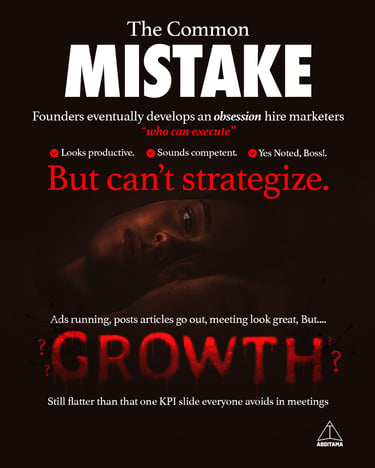
Every founder eventually reaches the same milestone: hiring someone to “do marketing.” The job description usually reads like you’re assembling the Avengers on a startup budget. You want someone who can run Meta Ads, create content, design presentations, write copy, analyze data, understand SEO, make viral TikToks, and somehow “own growth.” Then someone gets hired.
At first, everything looks promising. Ads are running. Social media is active. Reports arrive every Monday morning. Slack notifications never stop. Your marketer is busy. Very busy. Almost suspiciously busy. Yet a few months later, revenue hasn’t moved much, customer acquisition costs refuse to cooperate, and your growth chart remains flatter than that one KPI slide everyone quietly skips during board meetings.
The problem isn’t necessarily that you hired the wrong person. More often than not, you hired someone excellent at execution when what your business actually needed was strategic thinking.
There’s an important difference.
An operator keeps marketing moving.
A strategist makes sure marketing is moving in the right direction.
Warning Sign #1
They Wait for Instructions Instead of Creating Direction
Some marketers treat every Monday morning like they’re waiting for the next episode of a TV series. Before doing anything, they need instructions, approvals, checklists, and someone to tell them exactly what comes next. Their favorite sentence is probably, “Just let me know what you’d like me to do.”
They’re dependable. They execute tasks quickly. They’ll happily complete everything on the to do list. But they rarely ask whether the list itself makes sense.
Strategic marketers behave differently. They’re naturally curious. They question assumptions, suggest experiments, challenge ideas, and bring opportunities to the table before anyone asks. They’re constantly observing competitors, customers, market shifts, and emerging trends because they’re thinking beyond today’s task list.
Operators wait for work. Strategists create it.
Or, to put it another way, one behaves like a project management tool, while the other behaves like a business partner. Nobody hires Notion expecting it to develop a growth strategy.
Warning Sign #2
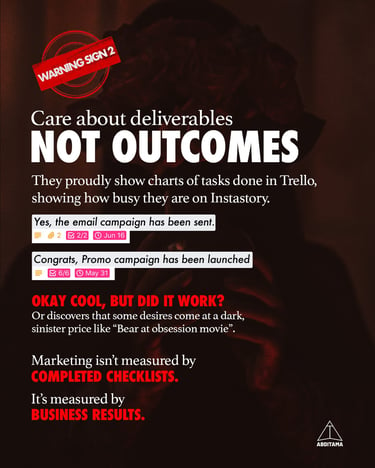
They Care More About Deliverables Than Results
There’s something strangely satisfying about crossing tasks off a checklist. Campaign launched, Email sent, Social media scheduled, Presentation delivered, Everything turns green in Asana, and suddenly everyone feels productive.
But marketing isn’t measured by how many things you completed. It’s measured by what those things actually changed.
Some marketers proudly post screenshots of their Trello boards on Instagram Stories as if being busy automatically equals being effective. Congratulations, the campaign has officially launched. The question is…
Did anyone care?
Did it generate leads?
Did it increase conversions?
Did it improve retention?
Or did we simply spend three weeks sending beautifully designed vibes into the digital universe like a late night Instagram Story that disappears before anyone remembers it existed?
Great marketers don’t celebrate publishing. They celebrate performance.
Warning Sign #3
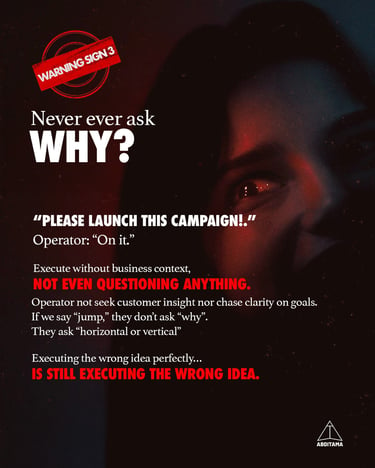
They Never Ask “Why?”
Execution without context is surprisingly dangerous. Imagine telling someone to build a bridge without explaining where it should lead. They might build an incredible bridge… to absolutely nowhere.
The same thing happens in marketing. When asked to launch a campaign, some marketers immediately begin designing, writing copy, or setting up ads without understanding the business objective behind the request. They don’t question the target audience. They don’t investigate customer behavior. They don’t ask what success actually looks like.
If you tell them to jump, they won’t ask why. They’ll ask whether you’d prefer horizontal or vertical.
Meanwhile, strategists can’t stop asking questions. Why this audience? Why this timing? Why this channel? Why would customers care? They’re not difficult. They’re trying to prevent the team from solving the wrong problem really, really efficiently.
Warning Sign #4
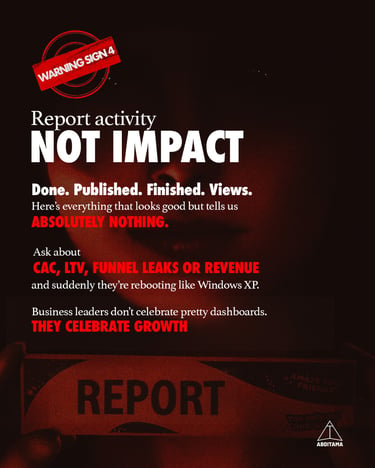
They Report Activity, Not Impact
Every marketer knows how to build a beautiful report.
Colorful charts, Clean dashboards, Impressive graphs. Everything looks fantastic until someone asks a very inconvenient question. “So… what did all this actually do for the business?” That’s usually the moment Windows XP starts loading in their head.
Strategic marketers don’t stop at reporting impressions, reach, clicks, or views. They connect those metrics to customer acquisition costs, lifetime value, conversion rates, retention, pipeline contribution, and revenue. They understand that business leaders don’t wake up wondering how many carousel posts were published this month.
They want to know whether marketing made the business healthier than it was yesterday. Pretty dashboards don’t pay salaries. Growth does.
Warning Sign #5
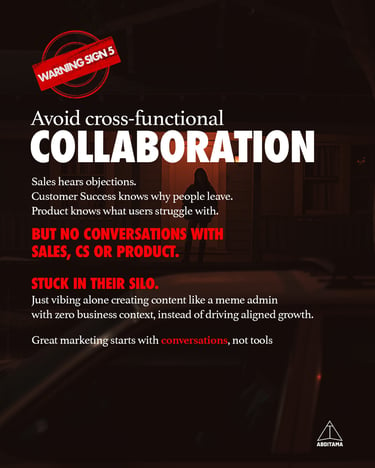
They Avoid Cross-Functional Collaboration
Some marketers spend their entire week inside Google worksheet, Ads Manager, and Google Analytics without speaking to anyone else in the company.
Meanwhile, Sales is hearing customer objections, Customer Success knows why people churn, Product understands what users struggle with, Support knows exactly which questions customers keep asking. And marketing… is busy choosing between two shades of blue for the next Instagram carousel.
Marketing doesn’t exist in isolation.
The best marketers constantly collaborate across departments because every conversation reveals another piece of the customer journey. Great positioning rarely comes from brainstorming sessions alone. It comes from understanding the business beyond the marketing department.
Otherwise, you’re simply creating content inside a very attractive bubble.
What We Actually Need
Businesses don’t simply need someone who knows how to use marketing tools. They need someone who understands how marketing creates business value.
That means thinking strategically before executing tactically. It means speaking the language of revenue instead of aesthetics, understanding customer behavior instead of chasing trends, and connecting insights, data, and commercial objectives before opening design tools.
Ironically, the best strategists are often excellent operators too. They know how to execute because they understand why the work matters in the first place.
The Truth
None of this means execution isn’t important. Execution is essential. A brilliant strategy that never gets implemented is just an expensive PowerPoint presentation with better typography.
But execution without strategy creates a different problem. Teams become incredibly efficient at producing work that doesn’t move the business forward. Campaigns keep launching, Content keeps publishing, Reports keep getting longer.
Growth, however, politely declines the meeting invitation.
Marketing plateaus faster than Threads’ daily active users, and eventually the acquisition funnel collapses with all the confidence of a crypto influencer explaining “why this time is different” during a bear market.
A Better Interview Question for Founders
Instead of asking candidates which tools they know or how many years they’ve managed Meta Ads, ask them to tell the story of a campaign they built from beginning to end.
Ask what business problem they were solving. Ask what customer insight changed their thinking. Ask why they chose that strategy instead of another. Ask what failed, what succeeded, and what they would do differently today. The answers tell you almost everything.
Operators usually describe what they did. Strategists explain why they did it. One gives you a timeline. The other gives you a way of thinking.
Closing
Every business needs people who can execute. Without operators, ideas never leave the whiteboard. But if execution is the only capability you hire, don’t be surprised when marketing becomes exceptionally good at staying busy while the business stays exactly where it is.
Hire marketers who understand customers before channels, business outcomes before deliverables, and strategy before software. Hire the person who challenges assumptions, not just deadlines. Hire the marketer who understands why the campaign exists long before deciding what color the call to action button should be.
Because businesses don’t grow from completed tasks.
They grow from better decisions. And that’s the difference between someone who simply does marketing and someone who leads it.