Understanding Know-How The North Star Metric to Navigate Business and Not Get Lost
Have you ever felt exhausted from working in a mediocre and incompetent organization? I certainly have. I had a challenging experience with a top-level management position where the leadership lacked the necessary experience, competency, and knowledge to effectively guide the team and navigate the business. There was a lack of clear direction and communication, which made it difficult to achieve our goals. This situation negatively impacted all teams within the organization, leading to unfocused work and constant disarray. So here is The Nort Star Metric, which helps teams move beyond driving fleeting, surface-level goals to instead focus on generating long-term retained goals in terms of the growth of the business.
BUSINESS
Denny Abditama
10/17/20253 min baca
In an era where dashboards are overflowing and every team tracks dozens of KPIs, many businesses still struggle with one fundamental problem: direction. You can be busy, data-driven, and growing, yet still feel unsure whether you’re building something that truly matters. This is exactly why the concept of the North Star Metric exists. Not as another metric to monitor, but as a strategic compass to help businesses grow without getting lost.
What Is a North Star Metric?
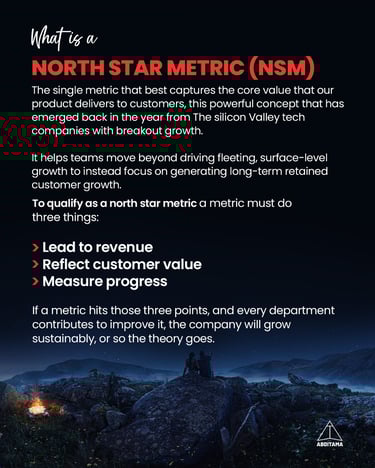
A North Star Metric (NSM) is the single metric that best represents the core value your product delivers to customers. The concept originated from Silicon Valley technology companies that achieved sustainable, long term growth. They realized that chasing short-term performance indicators often led to surface-level success, but not lasting customer value. To qualify as a true North Star Metric, a metric must do three things:
Lead to revenue
Reflect real customer value
Measure progress over time
If a metric satisfies all three criteria, and every team contributes to improving it, the company grows in a healthy and sustainable way.
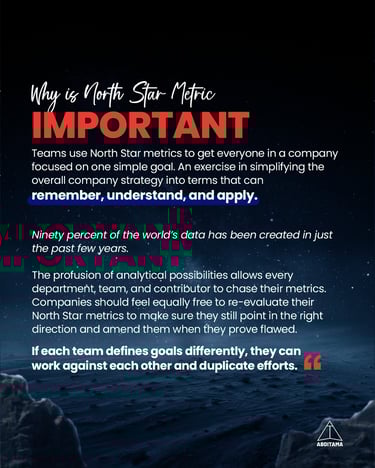
Why the North Star Metric Is Important
As companies scale, teams naturally define success differently. Marketing may focus on traffic. Product teams track feature adoption. Engineering optimizes performance. Customer support measures resolution time.
Individually, these metrics are useful. But without a shared North Star Metric, teams can unintentionally work against one another. The North Star Metric solves this by giving the entire organization one clear, shared goal, something simple enough to remember, understand, and apply in daily decision-making. This matters more than ever today. Nearly 90% of the world’s data has been created in just the past few years, making it easy to measure everything and understand very little.
A North Star Metric creates focus. And focus creates leverage.
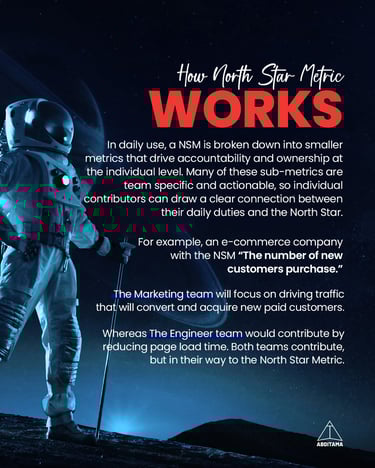
How the North Star Metric Works Across Teams
One of the most powerful aspects of the North Star Metric framework is that different teams contribute in different ways. Consider an e-commerce company whose North Star Metric is:
Number of customers who complete a purchase
Marketing improves traffic quality and conversion rates
Engineering reduces page load time
Product enhances discovery and checkout experience
Customer support builds trust and removes friction
Each team owns its own actionable sub-metrics, but all efforts ladder up to the same North Star. This creates alignment and accountability, connecting everyday work to long term business growth.
Vanity Metrics vs. North Star Metrics
A common mistake when defining a North Star Metric is choosing a vanity metric instead. Vanity metrics look impressive but fail to reflect customer value.
For example:
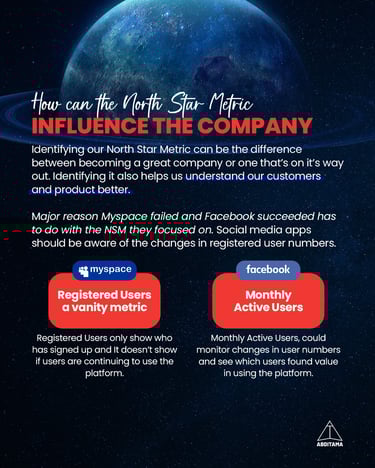
Registered users show how many people signed up
But they don’t show whether users actually engage or return
This distinction explains why Facebook outperformed MySpace. MySpace emphasized registered users, while Facebook focused on Monthly Active Users (MAU) — a metric that reflected ongoing engagement and real value. A strong North Star Metric doesn’t make you feel good. It tells you the truth.
How the North Star Metric Influences Company Growth
Correctly identifying your North Star Metric changes how you think about your product and customers. It helps companies:
Increase customer lifetime value
Reduce churn rates
Improve retention and engagement
Build products that customers genuinely rely on
Instead of optimizing for growth first, businesses optimize for value delivered and growth follows naturally.
How a North Star Metric Reflects Customer Value
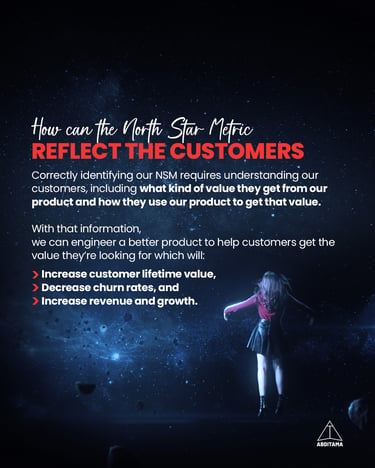
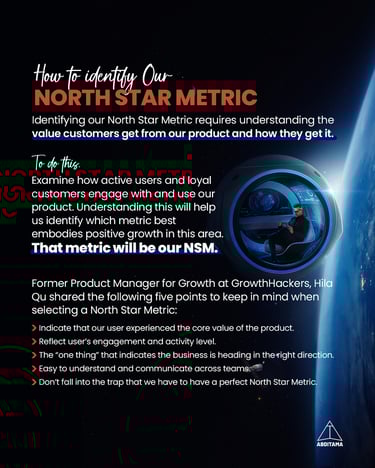
A North Star Metric must be grounded in how customers actually use your product. To identify it, analyze:
Behaviors of active users
Patterns among loyal customers
Actions that correlate with long-term retention
The right metric represents customers successfully achieving what they came for. When you understand this, product improvements become clearer and growth becomes a consequence, not a goal.
How to Define Your North Star Metric
Former Growth Product Manager at GrowthHackers, Hila Qu, suggests five principles for selecting a North Star Metric:
It indicates users experienced the product’s core value
It reflects meaningful engagement and activity
It signals the business is moving in the right direction
It’s easy to communicate across teams
It doesn’t need to be perfect — it needs to be useful
A North Star Metric is not permanent. As products and customers evolve, the metric should be reviewed and refined.
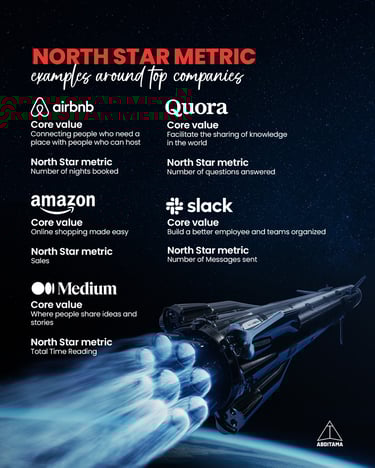
North Star Metric Examples from Top Companies
Different products create different types of value — and their North Star Metrics reflect that:
Airbnb
Core value: Connecting hosts and travelers
North Star Metric: Number of nights bookedMedium
Core value: Sharing ideas and stories
North Star Metric: Total time spent readingAmazon
Core value: Making online shopping easy
North Star Metric: SalesQuora
Core value: Sharing knowledge globally
North Star Metric: Number of questions answeredSlack
Core value: Improving team communication
North Star Metric: Number of messages sent
Each metric directly measures customer value, not internal activity.
Final Thoughts: Don’t Navigate Without a North Star
A business without a North Star Metric isn’t necessarily failing, but it is navigating without direction. Defining the right North Star Metric brings clarity:
To strategy
To product decisions
To how teams work together
In a world overflowing with data, clarity is one of the strongest competitive advantages you can build. Choose your North Star wisely and let it guide your growth.